


WWE’s Attitude Era: Austin, Taker, DX and the TV war that changed wrestling
Posted by INDEPENDENT LABEL
Broken glass, beer showers and arenas packed with homemade signs. The Attitude Era changed how wrestling looked on television and how it was made, sold and worn. Loud and impatient, tuned to a channel-surfing audience, it turned Monday nights into a cultural appointment.
The war on Mondays
The Attitude branding officially ran from Survivor Series on 9 November 1997 to the World Wrestling Federation’s rebrand to WWE on 6 May 2002. It unfolded in the heat of the Monday Night War against WCW’s Nitro, a broadcast fight that forced creative choices every week. By early 1997, Raw was struggling for ratings in the United States, a pressure that sped up the pivot to something harsher and more confrontational. Vince McMahon embraced a new direction as Vince Russo joined the creative team, and USA Network executive Bonnie Hammer worked extensively with Russo to reshape the programme. Russo has since said USA directly oversaw the product during his and Ed Ferrera’s tenure, with Ferrera serving as a USA consultant. It was wrestling hitting the accelerator to survive cable’s attention economy.

Austin lights the fuse
No one embodied the shift more than Stone Cold Steve Austin, the era’s most prominent star. Austin’s late-1996 to mid-1997 feud with Bret Hart stripped away the last of the cartoon gloss and brought a more combustible tone to prime time wrestling. It was belligerent, messy and hard to ignore. The pull-apart brawl with Mike Tyson in January 1998 pushed that energy into mainstream news, setting up a crossover spectacle that made WrestleMania a wider cultural talking point.
WrestleMania XIV delivered the seal of change. On 29 March 1998, Austin beat Shawn Michaels for the WWF Championship as Tyson’s presence amplified the glare beyond the usual wrestling press. The night after, Michaels began a long in-ring hiatus due to a serious back injury, and Raw moved forward with Austin as standard-bearer. The product spoke in a new register: looser scripting, improvised promos, coarse language and violent brawls, all set to a weekly pace that felt closer to live drama than family variety show.
DX takes a sledgehammer to the fourth wall
If Austin was the anti-authority face, D-Generation X was the gang that shoved counter-programming swagger into the foreground. DX officially formed on the 11 August 1997 episode of Raw when Hunter Hearst Helmsley, Chyna and Rick Rude aligned with Shawn Michaels. It was crass, juvenile and self-aware, and it resonated with a late-1990s audience who enjoyed seeing the product point the camera back at itself.
The timing mattered. As Michaels exited after WrestleMania XIV, Triple H grabbed the microphone on the 30 March 1998 Raw, announced the formation of the DX “army” and fired a verbal shot at his former partner. The group’s dynamic, bolstered by X-Pac, Road Dogg, Billy Gunn and Chyna, became a pop-culture touchstone in its own right. Years later, that line-up would be inducted into the WWE Hall of Fame during WrestleMania weekend, an acknowledgement of how decisively their irreverence rewired expectations for what wrestling could do on television.

Myth, menace and weekly cliffhangers
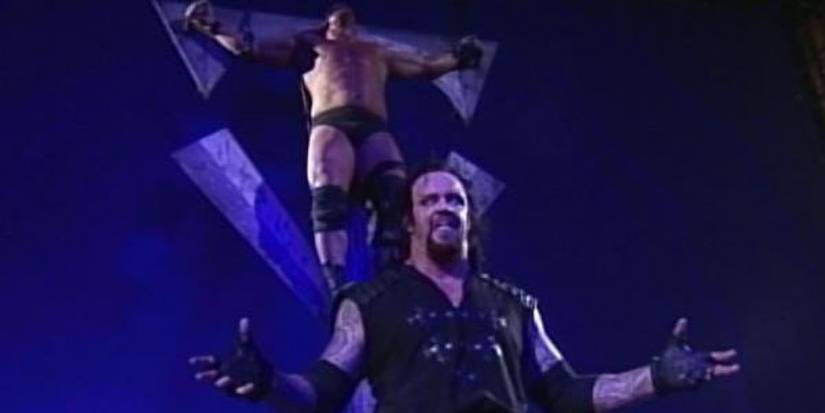
Attitude’s television language was blunt, but it also knew the value of myth. The Undertaker loomed over the period as a constant, a reminder that wrestling’s gothic streak and moral fables still had power even as the show lurched toward adult humour and office rebellion. Rivalries were drawn in thick strokes and resolved in ways that suited the grab-and-hold patterns of late-night cable. The cell, the chair and the camera became characters too, amplifying the sense that anything could happen at ringside.
Production loosened. Promos were often improvised. Performers such as Austin and The Rock coined catchphrases on air and carried that language out into the concourse on T-shirts. It was theatre built for the remote control: direct, quotable and reactive, with cliffhangers that invited you back next Monday.
Signs, slogans and the fan uniform
Look back at footage from 1998 and the audience almost glows. Homemade posters wave from every tier. Slogans turn whole sections into chanting blocs. That was not incidental. Merchandise and catchphrase synergy became a hallmark of the era. The sharpest lines were short enough to read in the cheap seats and quick enough to wear to school the next day. Wrestlers had input on what went on the shirts, so the link between a line yelled into the hard cam and the graphic outside the arena was unusually tight.
This emphasis on language turned consumer goods into fan identity. The shirt you wore declared whose side you were on before the theme hit. It also made the arena feel like a co-author. If a phrase connected, you saw it reflected back in fabric almost immediately. For WWE, it created a feedback loop where television writing, live reaction and retail all pulled in the same direction.
How television changed to win a fight
Attitude was as much about broadcast strategy as it was about creative taste. USA’s direct involvement, with Bonnie Hammer and Vince Russo working closely, helped set a tone that answered the realities of basic cable. The show courted shock, swerved formality and broke into mainstream headlines when it could. Crossovers mattered. So did the pace. Raw became a weekly serial that rewarded you for sticking around through the ad break.
The most decisive industry turn came later. On 26 March 2001, the WWF purchased WCW, and the moment was marked with an unprecedented simulcast of Nitro and Raw. The war that had shaped the product’s risk-taking instincts ended in a single television hour. Days later, attention shifted to WrestleMania X-Seven on 1 April 2001, headlined by The Rock versus Steve Austin with a surprise no disqualification stipulation added just minutes before introductions. Many fans and commentators now point to that event as a creative peak and a catalyst for the era’s eventual decline. Without a rival across the dial, the need to sprint every Monday eased and the company’s priorities shifted.
What Attitude got away with
No history of the period is honest without the caveats. The same looseness that electrified the product also normalised bloodied brawls and coarse language on prime-time television. DX’s swagger and Austin’s fury thrilled, but the era also leaned into frequent objectification of women on air, a stark contrast with the more competitive, sport-focused approach to WWE’s modern women’s division. It was a boom built on friction. Some of it still plays; some of it does not, and should not.
Why it will not return in full
Calls to bring back Attitude surface every few years, usually tied to nostalgia or a change in TV rating. The structural realities point elsewhere. Modern WWE’s strong finances, anchored by high-value television rights, Peacock’s licensing of the WWE Network and robust merchandise sales to younger fans, make a full return to Attitude-era content unlikely. When partners prize stability and brand safety, the camera does not swing as wildly as it once did. Even if regulatory room existed, the incentives have changed. You can borrow the cadence, but the business now runs on different fuel.
From broadcast war to wardrobe staple
The Monday Night War created a production mindset that treated every minute as a chance to keep the channel on. The results were often messy, sometimes objectionable and occasionally transcendent. The WWF won the industry war, bought its rival and entered a new corporate chapter. Wrestling moved with it, adjusting its tone and tactics as the business matured. The visual language lingered. Big block letters and black tees built a common wardrobe for fans that went beyond arenas, simple and high contrast for television and photographs alike.
If you still reach for that look, you are not alone. Independent Label regularly curates WWE pieces that tap into this late-90s energy, a nod to the part of Attitude that never really left, even as the business changed around it.
Two decades on, the Attitude Era reads like a primer on how sports entertainment reacts to a market crisis. It found a new tone, let its stars talk the way people actually talk and fused television, live crowd and retail into a single engine. The war ended and the brand softened, but the lesson endured. If you want wrestling to matter beyond the ring, you need stories that reward the live audience for being loud and the viewer at home for sticking around after the break. The fans handle the rest, one chant and one T-shirt at a time.
Shop WWE
Explore Independent Label designs inspired by WWE.

From N.W.A to Kendrick: the story of Compton rap
How the ladder match changed WWE, from Razor vs Michaels to Money in the Bank
Sun God Nika and Gear 5: how One Piece reimagined a shonen hero
From De La Hoya to Canelo: how Mexican boxing built the modern superfight
From GTA III to San Andreas: how the PS2 era reinvented the open world
The Undertaker’s many lives: how a 30-year persona kept wrestling haunted
Saiyan Pride and Rivalry: Goku, Vegeta, Frieza and the making of Dragon Ball’s myth
Demon Slayer’s Upper Moons explained: ranks, roles and rivalries

Shenmue and the birth of the living open world: how a Dreamcast gamble changed games
The Last Dance Effect: how the 90s Bulls made NBA style iconic again

