


Up in Smoke Tour 2000: how rap built its first arena blockbuster
Posted by INDEPENDENT LABEL
The liquor store lights flashed on cue. A short, brutal film had just rolled on the big screens, then the storefront set split and out walked Dr. Dre and Snoop Dogg as The Next Episode detonated across the arena. Flames, smoke, a roar that felt structural. Summer 2000’s Up in Smoke Tour wasn’t a typical rap bill scaled up; it was a purpose-built blockbuster that blended cinema with a generation’s worth of West Coast catalogue into a single, cohesive show. The blueprint for arena hip-hop travelled city to city with speakers, screens and a giant skull that talked back.
Aftermath rises, Shady detonates
The timing was precision. Up in Smoke kicked off on 15 June 2000 in the San Diego area at Coors Amphitheatre in Chula Vista, with Snoop Dogg performing at the opener. Early Southern California dates included the Arrowhead Pond in Anaheim that first weekend. Behind the scenes, promoters were nervous. Hardcore rap had rarely produced blockbuster tours at that point, and caution was sharpened by a high-profile stabbing at a Boston-area arena during another package earlier in the year. Contemporary coverage framed Up in Smoke as a counterweight, a production mounted to steady the reputation of large-scale rap shows without diluting the music’s force.
Two overlapping forces calmed the nerves. First, Dre’s catalogue had the weight to anchor an arena. As a producer and artist, his sound defined the era either side of the millennium. The Chronic and 2001 gave the tour the spine of a hits show and the pace of a studio mission. Second, Eminem was experiencing commercial gravity few artists ever see. The Marshall Mathers LP moved 1.8 million copies in its first week, a solo-artist record at the time, and the tour’s early sell-outs followed. Put bluntly, the combined pull of Aftermath and Shady made caution look outdated.

West Coast lineage, beyond any one label
Up in Smoke functioned as a West Coast roll call with added firepower. Headlined by Dr. Dre and Snoop Dogg, the bill also featured Ice Cube and Eminem, plus Proof, Nate Dogg, Kurupt, D12, MC Ren and Westside Connection across the run. It brought N.W.A alumni onto the same travelling stage, positioning Dre, Cube and Ren in the same ecosystem again and crystallising a lineage that predated the late-90s label drama. The era’s power players weren’t just sharing the marquee; they were showing how their catalogues linked in real time.
Ice Cube used the spotlight to stitch his film work into the night. You Can Do It arrived with an explicit plug for Next Friday, cinema and stage feeding each other. Elsewhere, Hello was staged with a dramatic, icy entrance, part of a wider aesthetic where the visuals kept pace with records built for subwoofers. The point wasn’t to recreate a mixtape on an arena PA. It was to reframe West Coast rap as spectacle without losing the menace of the music.
How the show looked, sounded and moved
The production language was both blunt and playful: explosions punctuating drops; a massive, talking skull looking down on thousands; glowing cannabis leaves threaded through the set like a recurring wink. Video interludes did more than fill changeovers, they set pace and place. The liquor store prologue before Dre and Snoop’s joint set gave the night a filmic hinge, then the headliners burst through the set as The Next Episode hit.
Neil Strauss wrote at the time that Up in Smoke set a new standard for live rap spectacle. Stereogum has since characterised it as the most elaborate travelling rap show mounted up to that point. Those assessments track with what people saw in the room and later on disc. The tour arranged rap’s familiar elements into a stage grammar arenas could understand: hard cuts, blackout gags and a camera plan ready for the big screens. It was brash and tightly cued.
Cameos, medleys and the science of sequencing
Up in Smoke worked because it built a night around collaboration, not competition. Special guests became structural. Nate Dogg’s velvet hooks stitched sets together, swinging choruses like pivots so the energy never stalled. Kurupt brought steel to features that needed an extra edge. Xzibit roared through his moments with the kind of projection that reads from the upper tier. D12 and Proof hardened Eminem’s section, giving his part of the night the crew weight that live rap often lacks.
The sequencing folded hits into short, relentless runs. Chorus fragments, guest verses and full records assembled into a near-continuous movement, heavy on handoffs. What could have felt like a rotating showcase read instead as one company of performers moving through shared material. Dre’s role as producer helped that coherence. Tracks from The Chronic and 2001 were the show’s central nervous system, giving different performers a common reference and sound palette. When the night needed a jolt, there was a bassline ready to go.

Visual language at arena scale
The proposition was simple: make a massive room feel the shock and humour of West Coast rap’s visual cues. The show leaned on recognisable motifs and outsized props to turn a sports arena into a set that matched the music’s punch. The talking skull became a character in its own right, part host and part menace. Cannabis-leaf greens glowed across trusses and screens. The precision of the cues mattered. These were theatre tricks grounded in the songs, calibrated to read from the floor to the rafters.
Reassuring the industry, without softening the edges
In 2000, promoters were jumpy about large rap shows. The Los Angeles Times reported industry caution, sharpened by a stabbing at a Boston-area arena earlier that year. Up in Smoke answered with polish out front. The music stayed combative. The screens, pacing and set architecture addressed the optics, projecting control. You did not need a press release promising safety; you could see it in the way the night ran to time and scale.
Commercially, the timing of Eminem’s album-release burst simplified the calculus. With The Marshall Mathers LP selling 1.8 million in week one, the risk-reward ratio shifted. Arenas booked, tickets moved, and the tour’s early dates proved the appetite was there for a rap show that thought like a blockbuster. The calculation paid a cultural dividend too, resetting what rap could look like at that scale.
The concert film that sealed the memory
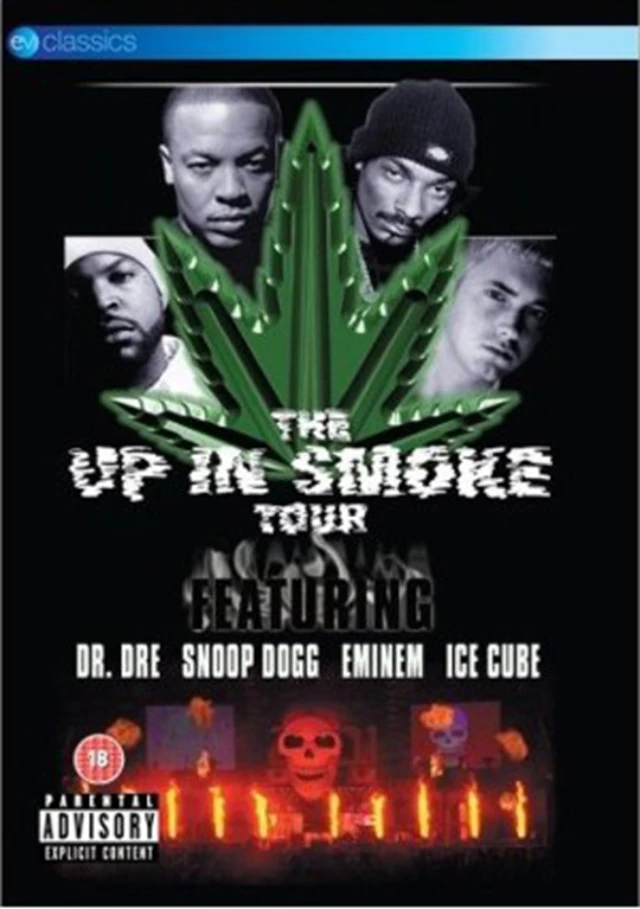
Part of Up in Smoke’s endurance is how quickly it was archived at volume. The tour was captured as a concert film, The Up in Smoke Tour, directed by Philip G. Atwell and featuring Dr. Dre, Snoop Dogg, Eminem and Ice Cube. Running around 1 hour 59 minutes and released on 2 December 2000, it landed squarely in the DVD-boom moment. For many fans who missed the dates, that disc was the show, complete with the talkative skull, the film interludes and the big-screen grammar that carried the spectacle from stage to sofa.
The DVD also made its aesthetics portable. Freeze-frames of glowing leaves and chrome-toned set pieces seeped into poster collections and pinboards. More importantly, it set the expectation that if hip-hop filled arenas, it would also live as a visual document with the same care as a studio album or a film soundtrack. That idea spread. If you mount an arena-rap production now, it feels natural to imagine the camera rig and the post-production pass at the planning stage, not as an afterthought.
What remains
Two decades on, Up in Smoke is remembered as a summer run that made sense of the arena for rap on rap’s terms. Contemporary critics said as much, and the footage confirms it. When hip-hop headlines festivals now or mounts multi-artist arena bills, you can feel the echoes: the insistence on narrative, the comfort with cinema, the producer’s ear guiding the night’s spine, the totemic objects that give a vast room a focal point.
For those who collect the era’s visuals, the look of Up in Smoke endures too. If that aesthetic speaks to you, we’ve pulled together a small edit in the Independent Label shop inspired by 2000 tour graphics and West Coast stagecraft, a nod to the show that proved hip-hop could speak arena fluently.
What Up in Smoke ultimately offered was proof of concept. Hip-hop could build a blockbuster without borrowing the posture of rock or the scaffolding of pop. It could bring a liquor store to the stage, drop a film in the middle of a set and still hit with the weight of a city behind it. The arenas listened. The cameras rolled. The rest followed.
Shop Up in Smoke Tour 2000
Explore Independent Label designs inspired by Up in Smoke Tour 2000.


Wembley Nights: how British heavyweights brought back the stadium superfight
From N.W.A to Kendrick: the story of Compton rap
How the ladder match changed WWE, from Razor vs Michaels to Money in the Bank
Sun God Nika and Gear 5: how One Piece reimagined a shonen hero
From De La Hoya to Canelo: how Mexican boxing built the modern superfight
From GTA III to San Andreas: how the PS2 era reinvented the open world
The Undertaker’s many lives: how a 30-year persona kept wrestling haunted
Saiyan Pride and Rivalry: Goku, Vegeta, Frieza and the making of Dragon Ball’s myth
Demon Slayer’s Upper Moons explained: ranks, roles and rivalries
Shenmue and the birth of the living open world: how a Dreamcast gamble changed games

